
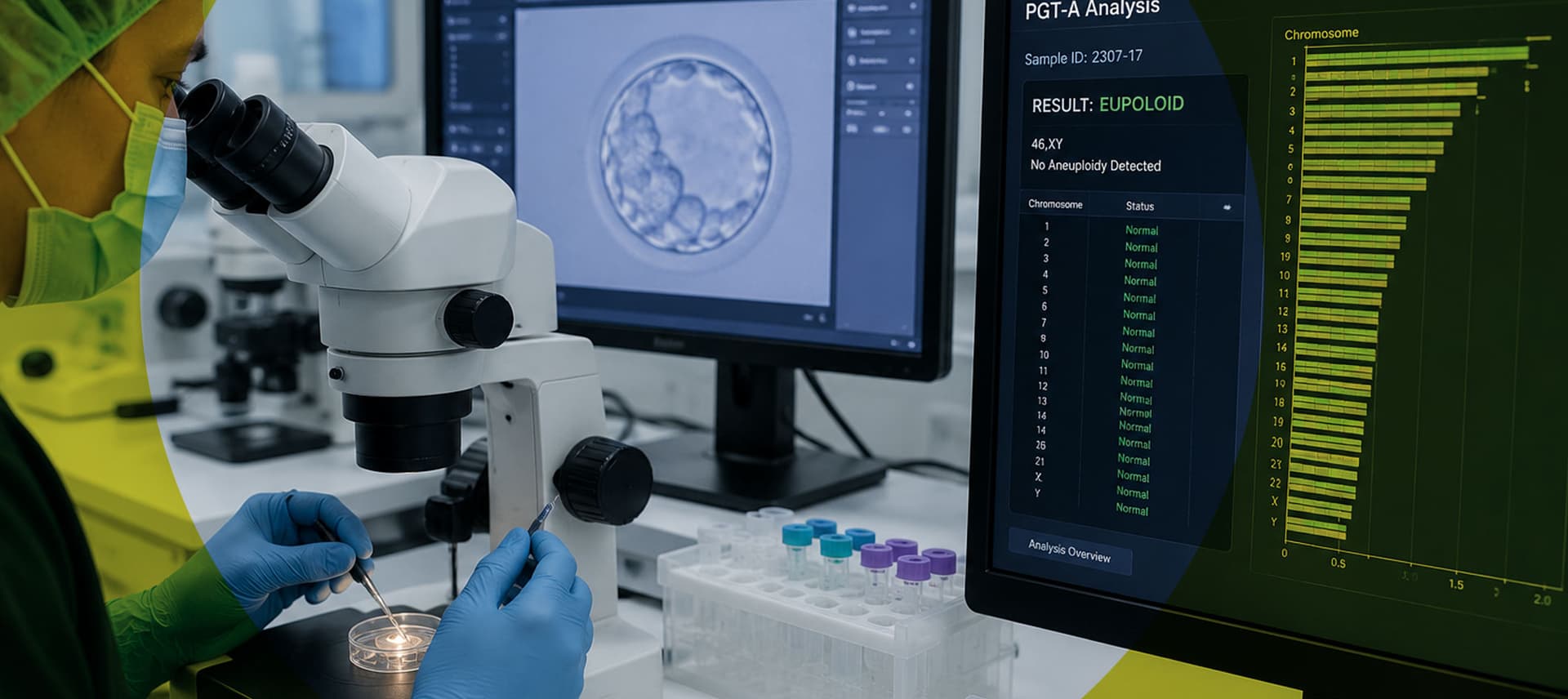
In previous embryo posts I've mentioned "tested embryos" more than once – and promised to elaborate. So here it is: PGT-A is the genetic test that has become almost the default in U.S. surrogacy journeys in recent years, and it's also one of the decisions that raises the most questions among parents. Let's understand what it does, what it doesn't do, and when it's worth every dollar.
What it actually is: on day five or six of the embryo's development, at the blastocyst stage, the embryologist takes a few cells from the outer layer – the one destined to become the placenta, not the fetus itself – and sends them for chromosome counting. An embryo with a normal chromosome set is called euploid; an embryo with missing or extra chromosomes – aneuploid – is the most common cause of implantation failure and early miscarriage. The test, in simple words, flags in advance which embryos have a real chance.
Why does it matter especially in surrogacy? Three reasons. First – efficiency: when every transfer involves coordinating with a surrogate, medications, flights and payments, you want every attempt to count. Transferring a high-probability embryo saves months and tens of thousands of shekels of futile attempts. Second – reducing miscarriage risk, which is a hard event for everyone and especially for the woman carrying for you. Third – it's what enables the single-embryo-transfer policy I wrote about: clinics confidently transfer one embryo precisely because it's been tested.
So what are the downsides? First, the price – testing adds thousands of dollars to embryo creation. Second, the test isn't perfect: a "mosaic" result (some cells normal, some not) creates dilemmas, and there's a lively professional debate about such embryos – some of which have produced perfectly healthy babies. Third, and most important to understand: PGT-A counts chromosomes only. It is not a "full" genetic test, doesn't detect specific hereditary diseases (there's a different test for that, PGT-M, for those it's relevant to), and doesn't guarantee a healthy baby – it improves odds; it doesn't issue warranties.
And when does it matter less? The younger the egg donor, the higher the share of normal embryos anyway. With a 22-year-old donor, some doctors will say the benefit is marginal; with older eggs – the picture flips. That's exactly the conversation to have with your doctor, with your numbers on the table.
My tip: if you decide to test – test all embryos from the cycle, not just some. The per-embryo cost is small relative to the cost of an unnecessary transfer, and the complete information will help you plan properly for the next child too.